Search This Blog

Showing posts with label Ulverston. Show all posts

Sunday, 19 September 2010

Quaker War Memorial from Wigton!

I guess the idea of a Quaker war memorial seems a bit odd - but two have turned up and one, a chair, has come to a temporary rest at Swarthmoor Hall while a permanent home is found.
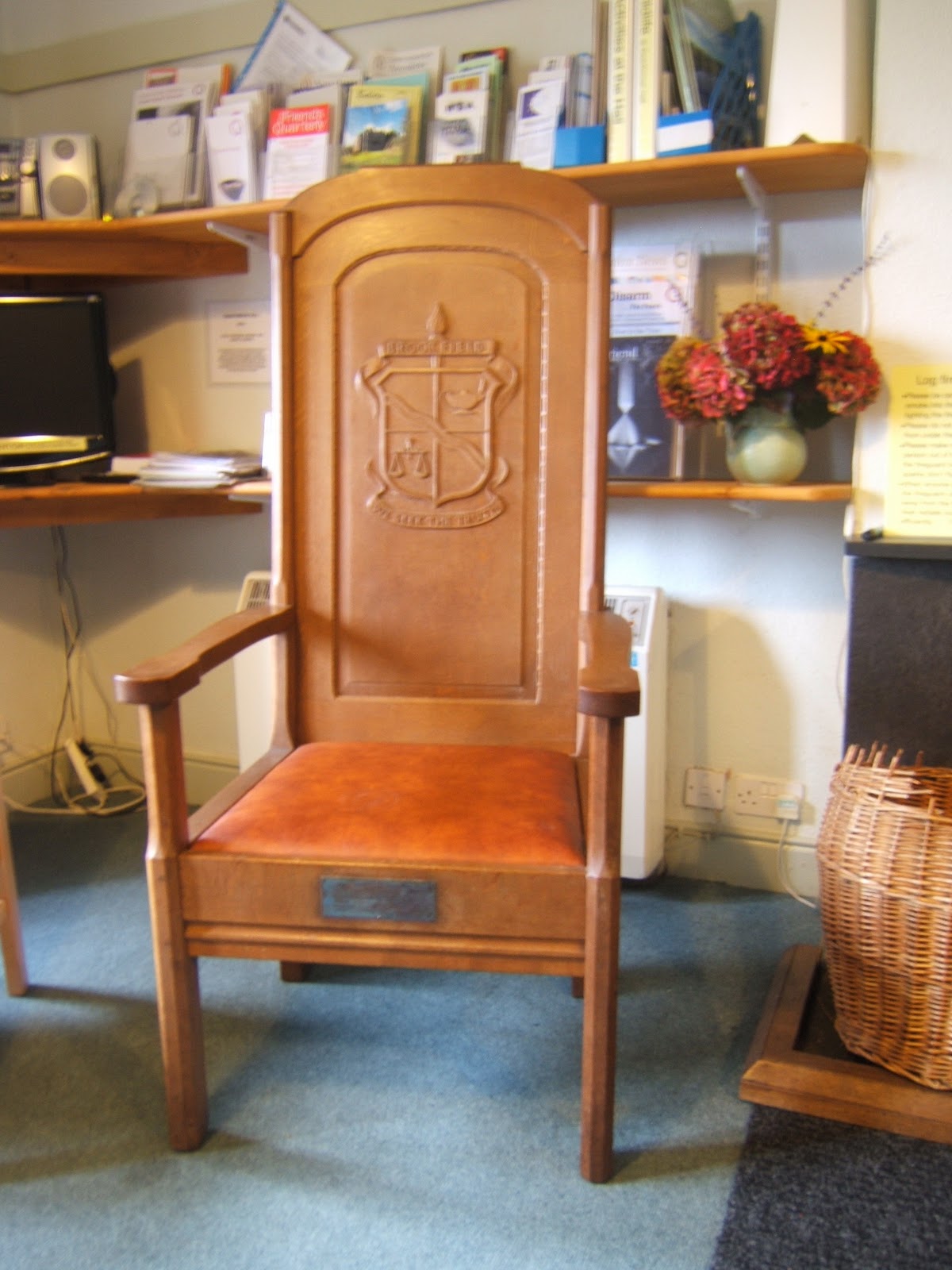


The memorials were at Brookfield School, Wigton, a Quaker school founded in 1815. The premises were originally at Highmoor and moved to Brookfield in 1827. The school closed in 1984 and passed out of Quaker hands. It was presumably at this time that the memorials were removed, I believe, to Wigton Meeting House.

The chair bears a plaque naming the old boys of Brookfield School who died between 1939 - 45.


The men named:

Rowland S Armstrong is named on the CWGC website as Roland Scott Armstrong, son of George Lee & Margaret of Carlisle. He was posted 'missing believed killed' aged 22 as an Acting Sub Lt RNVR, 854 Squadron, Fleet Air Arm, flying Avenger IIs on January 29, 1945 while serving aboard the aircraft carrier HMS Illustrious. The carrier was part of Force 63 making a raid on Soengi Gerong oil refineries near Palembang. Casualties were incurred by stray anti aircraft shells fired by HMS Euryalus which was engaging Japanese Kamikaze attacks. 11 were killed and 22 wounded. Was Rowland one of these or was he killed while flying?


Edward Coward is probably Edward Mason Coward, First Radio Officer, Merchant Marine. The only man of this name on the CWGC Register died serving aboard the SS Traveller of Liverpool on January 26, 1942 aged 20. She was torpedoed by U106 in the North Atlantic with the loss of 50 lives.


113798 Selby Greenop, Flight Lt, RAFVR, son of Harold & Janet Greenop of Carlisle. Selby was killed on November 7, 1944 in one of the many forgotten tragedies of the war when Landing Ship Tank 420 carrying No 1 Base Signals & Radar Unit to France hit a mine off Oostende. 14 Officers & 224 other ranks were lost; just 31 men survived. The unit was wiped out. Selby is buried at Oostende New War Cemetery. LST 427 is seen below, they carried huge amounts but sank like stones.


Leutenant Stanley Learmouth Haydock, RN, died aboard the Portsmouth destroyer HMS Acasta on June 8, 1940 aged 25. He was the son of Hugh & Isabel Haydock of Upminster. The Acasta was lost off Norway while sailing with HMS Glorious, see here for a posting about the terrible events of that day.


23 year old Flying Officer Gordon Noble Leach, RAFVR, was piloting Stirling LK 502 on a night photo training mission from RAF Wigsley on May 27, 1944. The plane developed Engine trouble and crashed at Cliffe Park, Rudyard, Leek, Staffs. Four crew were killed, four survived. Gordon was the son of James and Janet Noble Leach of Newcastle on Tyne. He was cremated at Newcastle Crematorium. This is the crash site.


927407 John Watson Leathes, aged 31, served in India as a Serjeant with 51 Battery, 69 Field Regiment, Royal Artillery. He died of unknown cause on November 1, 1944 and is now buried at Kirkee War Cemetery, nr Poona.


George Robertson & David Smith must, for the present, remain anonymous. Their names are too common to be easily identified.

Many Quakers struggled with their consciences at the outbreak of WW2. Though committed to pacifism Hitler was sufficiently bad news for some to put this principal to one side. Others did not. There is no way that I can easily ascertain how many of the men were Friends and how many simply attended the school as non Quakers.

I have just had the following email:

The chair was made by Stanley W Davies (see Wikipedia) for the Old Scholars Association of the Friends' School Wigton shortly after the war. I was a younger pupil at the same time as some of  people commemorated.George S Robertson was a pupil from 7/1934 to 12/1939 and served in the RAF. He was the elder son of  Robertsons who were the foremost bakery firm in Carlisle. David Smith is recorded in the School history as coming from Low Fell.  He was a pupil from 5/1933 to 7/1937. Unfortunately I do not have any information about which service he was in. I hope this may be of some use in identifying them.

There is a WW1 memorial in the form of an oak plaque presently in the Meeting House at Wigton. The building is shortly to be sold and the plaque will be removed to Ackworth School.


As a consequence of receiving this email Robertson can now be identified as 1821069 Sergeant (Air Gunner) George Smith Robertson RAF Volunteer Reserve, 106 Squadron. A Lancaster in the Squadron's markings is seen here.
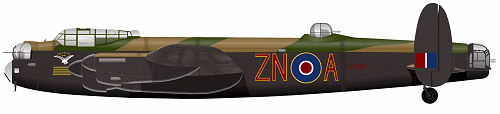

Robertson was killed on 31st March 1944 in the great raid on Nuremberg.

... This would normally have been the moon stand-down period for the Main Force, but a raid to the distant target of Nuremberg was planned on the basis of an early forecast that there would be protective high cloud on the outward route, when the moon would be up, but that the target area would be clear for ground-marked bombing. A Meteorological Flight Mosquito carried out a reconnaissance and reported that the protective cloud was unlikely to be present and that there could be cloud over the target, but the raid was not cancelled.

795 aircraft were dispatched - 572 Lancasters, 214 Halifaxes and 9 Mosquitos. The German controller ignored all the diversions and assembled his fighters at 2 radio beacons which happened to be astride the route to Nuremberg. The first fighters appeared just before the bombers reached the Belgian border and a fierce battle in the moonlight lasted for the next hour. 82 bombers were lost on the outward route and near the target. The action was much reduced on the return flight, when most of the German fighters had to land, but 95 bombers were lost in all - 64 Lancasters and 31 Halifaxes, 11.9 per cent of the force dispatched. It was the biggest Bomber Command loss of the war.


Sunday, 17 January 2010

Peace and after

Killing is remorselessness in the history of Cumbria, Britain and indeed human history and then the paradox that, following such events, people invest such efforts into the remembrance of the consequences like a belated guilt trip. But remembrance of war is a complicated business encompassing national euphoria and vast grief. It has always been thus.

I have just finished reading a biography of Queen Elizabeth I by Allison Weir in which there is a description of the celebrations held throughout England following the defeat of The Armada. A famous image commemorating this great naval victory is the Armada Portrait of Gloriana herself commissioned in the year of the battle, so called from the images of the action seen in the background.


I have it in my mind that trees were also planted that year though I cannot be certain where. But tree planting became an established form of memorials commemorating war and peace, and great national events. This picture shows a tree planting somewhere around the Cartmel peninsula in the early years of the twentieth century. Judging by the fashions it is probably Queen Victoria''s Jubilee or the coronation of Edward VII or GeorgeV. There are many examples in Cumbria of trees being planted to celebrate such events and also following conflict many after 1918.


After the peace of 1919 there was a degree of confusion over what memorials were commemorating. Although they have come to be seen as memorialising the dead, to contemporaries there was also the important issue of service to King & Empire and the celebration of a Great Victory. Thus many towns and villages displayed military hardware, items that now seem incongruous. Militarism, however, was a central part of the Victorian ethos of the Muscular Christian Crusade against the forces of barbaric darkness that lay beyond Dover. Commemorations throughout the 19th century often employed martial images. The pic here shows the celebrations in Grange over Sands following either the Relief of Ladysmith in 1900 or the ending of the Boer War a couple of years later. Can't imagine such as this in the Ulverston carnival.


As described elsewhere on this blog peace after the Great War was only celebrated after the signing of the final Peace Treaty at Versailles on June 28, 1919. The King decreed that July 19th be designated 'Peace Day' and communities all over the country contrived celebrations. There was talk of beacons being lit throughout the country as had happened in 1588 when the Armada was sightedbut it never came to pass. Below is a pic of the peace parade in the Arnside/Silverdale area.


It is of course the memorials of the Great War that are central to our understanding of the processes of memorialisation. This last year saw the death of the last soldiers and sailors from this conflict. In the 1920s & '30s pretty much everyone who gathered at memorials were there because of The Somme, Passchendaele, Gallipoli and a hundred other battlefields of 1914 - 18. The men had experienced it, wore their medals and marched proudly like these guys in Church Walk, Ulverston.


The rituals of Remembrance became established and persist to this day, though the sentiments have subtly changed and we no longer have soldiers with rifles reversed. There were more people attending then. Unlike in Blair's wars the entire nation was touched by recent events and more respectful of authority.


The building immediately behind the cross was demolished to make way for 'Woolies'. In the mid 19th century an upstairs room was the venue for an annual reunion of Furness men who had served with Wellington and Nelson.

Wednesday, 18 November 2009

Lost memorial found

Got round to visiting Sir John Barrow junior school in Ulverston where a memorial, walled up thirty years ago, re-emerged during recent building works.
It was both disappointing and fascinating!


The memorial, if such it is, was painted directly onto the wall and clearly shows the Arms of King George V and the date 1917. Unfortunately there is more disappearing into the ceiling that has not emerged during recent renovations. If there is a list of names or a clear indication that it is a memorial then it must be hidden there.

A small panel at the bottom tells the viewer that it was presented by J Martin Esq on March 9th 1917.


As can be seen on the lower pic it is quite badly damaged by people using it as a notice board of some sort. It is badly pitted with holes from, presumably, drawing pins and such.

Saturday, 4 July 2009

Another country, another war

I love cemeteries.

They are places that are overflowing with history, of peoples lives and of attitudes not simply to death, but also to life, to those things that were held to be of highest value in the lives of the dead or which defined their status in life - for it is these achievements that are recorded on the memorials. Most often it is their professions that are remembered, architect or farmer, sometimes their qualities. But occasionally it is something quite different.

Thus in Ulverston cem there are two gravestones standing side by side that record the lives of various members of the Birrell family.


That on the left remembers Andrew Birrell of Swarthmoor Hall who died on the 31 August 1883, aged 59 years. Below his name are those of Margaret, his widow, who died at Rosside House in 1902 aged 72; Robert, their son who died aged 18 in 1873 and finally Andrew Birrell Kitchin, their grandson who died in 1884, aged 1.

I have an interest in Swarthmoor Hall, a beautiful old house nr Ulverston, the spiritual home of The Quakers. As a consequence of my interest I looked into the family and it was quite fascinating. Andrew Birrell came down from Carlisle, via Brigham & Lamplugh where his children were born, and farmed at Swarthmoor from the 1860s. After he died his widow, Margaret, continued at The Hall into the 1890s which is when this photo would have been taken.

The seated lady is Mary Snowden, an American Quaker. And that is a bit of a coincidence. In the 1830s Andrew Birrell himself was in the USA, his return by boat is recorded online.

And then to return to the two gravestones - the one on the right is;

In Memory of
Adam Birrell
Private, Co H, 9th Regiment
Indiana Volunteer Infantry
United States America
Who died at Rosside House
March 14, 1901
Aged 71 Years

He must be a veteran of the American Civil War.

This old photo shows members of Adam Birrells unit during the conflict, in this case Company A, but Adam probably knew them.

I cannot trace the birth of Adam Birrell but he must have been a brother or cousin of Andrew, certainly a close relation. They were probably in America together in the 1830s. Andrew returned home to farm at Swarthmoor, Adam stayed on to fight for the Union only to return to England to die. Clearly he or his extended family felt that whatever else he might have done in life, his service in the Union Army was the achievement for which at considerable expense he should be remembered.

Remarkable

Thursday, 13 November 2008

Brian McGuire, Royal Dublin Fusiliers - killed at Mons 1914

There are many sad stories associated with memorials throughout the county - pretty obvious really. But when I was first getting involved in them I found one which seemed to say a lot about the way in which the dead of the Great War were remembered until quite recently. To all intents and purposes they were largely forgotten - and indeed many, including this guy, still are. Nor is it everyone who treats memorials with the respect that they deserve.


In Ulverston cemetery there are quite a number of family headstones & gravemarkers that bear the names of men who died during, or as a consequence of, the Great War. One such is this neglected memorial to the McGuire family.


The memorial itself is broken. The cross which originally surmounted the base, & which has vanished completely, probably fell as the monument sank into the grave. Upon the base can be read the words;

In Honoured Memory of
Brian McGuire, 2nd Lt
Royal Dublin Fusiliers
Younger son of
George McGuire
Fell at the Battle of The Aisne, France
14th Sept 1914, aged 20 Years
How sad that it is so neglected. But it seems that there was probably no-one to care for it.

Brian's father died on May 8, 1899 aged 37 and is buried in this plot with Eleanor, Brian's grandmother, who died August 3, 1880 aged 50. In his working life George was Town Clerk of Bradford. Brian's medal card shows that his mother, Florence Hannah, remarried becoming Mrs Craven. She probably lived at Collingworth, Yorkshire in 1914/15 and later in 1917/18 at Beaufort Mansions, Chelsea. By the early '20s she was at 'The Bungalow', Freshwater Bay, Isle of Wight.


Young Brian McGuire is buried at Vauxbuin, a concentration cemetery adjacent to large French and German war cemeteries. It was established after the armistice and contains close to 300 British dead of which 162 are identified. These bodies, mostly of 1918 casualties, were brought in from about a dozen dispersed burial sites around Soissons. Interestingly the CWGC website indicates that one grave at Vauxbuin contains the remains of a man killed in September 1914 and whose initial burial place was at Pargny-Filain, a German Communal Cemetery. Was this Brian McGuire?


I briefly checked on the web to see whether Brian McGuire is listed on Bradford's Memorial and was appalled to discover that a week before Armistice Day, 2008, many of the bronze plaques naming the dead had been ripped off the memorial and stolen.


Monday, 18 August 2008

A statistic

When discussing the losses in the Great War, and specifically those suffered by the industrial communities of the north such as Accrington, the focus is invariably on the Pals Battalions; units raised in local neighbourhoods and often stripping whole streets or factories of young men. However, the appalling losses of such as the Accy Pals at Serre on July 1 1916, were often suffered by territorial units. Maybe not quite so bad, but bad enough.


The graph below shows when the men and boys listed on Ulverston's primary memorial were killed. (August 1914 to December 1918).


The most striking feature is the huge peak of July (14), August (25), September (8), 1916 when the lads were fighting on The Somme. Nothing approaching such a concentrated loss was experienced before or after. Nor should it be forgotten that for every man killed approx 3 would be wounded - thus, with 47 dead, 'Lile Oosten' probably suffered a total of some 200 casualties during this period. 20 of these men were killed in July/August fighting with the 1/4th King's Own, the local Territorial unit that recruited throughout Furness and Cartmel. Indeed in the whole three month period the unit lost 194 men killed and perhaps 500-600 wounded.


These casualties were largely a consequence of the attempt the break the second German line on The Somme at Guillemont. The men of Furness and Cartmel attacked a quarry to the north west of the village from a start line at Arrow Head copse just to the west of 'The Sunken Lane'. They were cut to pieces. A description of this place is contained in Ernst Junger's classic 'Storm of Steel'; as a young German soldier Junger was fighting in The Sunken Lane some weeks after the 1/4th attacked. Check out http://leoklein.com/itp/somme/texts/junger_1929.html . The pic show the site of Guillemont Station some 200 yds north of where the ulverston lads fought. This was a railway station! The village used to be on the horizon!


One of those killed, on 8 August, was John Burrow, Assistant Master in Dalton School. He is buried at Guillemont Rd Cemetery - close to Raymond Asquith, son of Herbert Asquith, Prime Minister in the early years of the war. Raymond's grave is just to the left of the entrance, seen here. John's is at the back of the cemetery.


John Burrow was an old boy of Ulverston Victoria Boy's Grammar and although his name is on the school's memorial his photograph does not seem to appear on the school's photographic roll.

Of all the guys killed in this three month period, July - Sept 1916 and named on Ulverston Cross, one died in Tanzania, one in Iraq, one at Ypres and two at home. The rest were killed on the Somme. 26 have no known grave and are commemorated on the Thiepval Memorial to The Missing of the Somme.

The graph is interesting in other ways. The first peak of casualties (reading from the left) illustrates losses suffered at Festubert in the summer of 1915, shortly after the 1/4th went to France. Also the losses of 1918 (54) approached those of 1916 (69). Indeed for the country as a whole the casualties increased in each year of the war. It is only in small communities, such as Ulverston, that the losses are skewed by the involvement of a territorial or a Pal's Battalion.

Monday, 19 May 2008

An interesting aside!


As the years of my life have passed the realisation has dawned that I have become part of history. My memories of the '60s could now form part of a History module at University, and how I regret not talking more to my Gran about Victorian Burnley or to my Father about his desert war. And there are other missed opportunities. When I first came to Ulverston some 30 years ago a cousin of my Father's, Aunt Renee Ferrier, told me that she knew the town well. From 1940 - 45 she was an ambulance driver at Conishead Priory, now the Manjushri Tibetan Buddhist Centre but at that time a military hospital.


I wonder whether she knew Maximilian von Herff?


Born in Hanover on April 17, 1893 Von Herff served throughout the Great War attaining the rank of Colonel and winning the Iron Cross first and second class. During the second war he fought in North Africa under Rommel, most notably during the German attack of spring 1941 and the subsequent investment and siege of Tobruk. During this action he led Kampfgruppe Herff westwards beyond the Cyrenaican/Egyptian border liberating Fort Capuzzo and Bardia and capturing the town of Sollum and by the end of April the strategically important Halfaya Pass. In June of that year he was awarded the Knight's Cross.

However, on April 1, 1942 Von Herff joined the Nazi Party, (member no 8 858 661) and the SS (no. 405894). From October 1942 until May 8, 1945 he was in charge of the SS-Personalhauptamt, the personnel department of the SS, being further promoted to SS-Obergruppenfuhrer and General in the Waffen SS during April 1944.

After his capture he was a Prisoner of War at Grizedale Hall POW camp but was taken ill and died at Conishead Priory.

The first pic shows Grizedale camp during the war.
The pic below shows the hall as it featured in the film The One That Got Away, relating the story of Oberleutnant Von Werra a Luftwaffe pilot who attempted an escape.

Initially Von Herff must have been buried in Ulverston cemetery but together with all the other German war graves in the UK he was subsequently reinterred at Cannock Chase German War Cemetery, Staffs. There is, however, an added irony. Had he lived he would, as a high ranking member of the Schutzstaffel, almost certainly have been indicted to appear at Nuremberg to answer charges of War Crimes. Here he would have faced Norman Birkett KC, deputy to Lord Justice Lawrence, Britain's chief prosecutor.

Norman Birkett was an Ulverston lad who in 1958 was created 1st Baron Birkett of Ulverston. So it seems that the unfortunate Von Herff was destined to engage with Ulverston whatever his fate!

It might be a mere coincidence but in his memoirs that most decent and chivalrous soldier, Feld Marschall Erwin Rommel, briefly describes the actions of the Kampfgruppe but never mentions Von Herff by name.

As a final note - Lord Birkett has an excellent quote listed in the Oxford Dictionary of Modern Quotations:

'I do not object to people looking at their watches when I am speaking. But I strongly object when they start shaking them to make certain they are still
going.'

Friday, 16 May 2008

Ulverston Victoria High School

After the Great War schools, particularly Grammar Schools, were keen to establish memorials to old boys, & occasionally girls, who had served or died. That at Ulverston Vic, formerly the Grammar School, is a rather fine example. The school magazine for Christmas 1919 describes the unveiling by Lord Richard Cavendish of Holker on December 12 , as a 'solemnly-impressive ceremony'.


The memorial's cost was £194 1s 9d. It was made by James Powell & Sons (Whitefriars) Ltd, London, commonly abbreviated to Powell of Whitefriars. The firm, established in 1834 when James Powell bought the Whitefriars glass factory, was a major manufacturer of scientific glass, fine art glass and stained glass windows but it also established itself as an enterprise able to create memorials and ecclesiastical pieces in a variety of styles. Going round Cumbria I have a suspicion that quite a number of unascribed memorials are works by Powell. Ulverston Vic's however, is a classic example of craftsmanship in glass. The main body of the memorial is of a beautifully veined green marble inlaid with decorated black marble name panels. The names themselves are cut and gilded, as is the dedication at the bottom -

In grateful memory of members of this School who died for England in the Great
War.

At the top is an alabaster cartouche of the Royal coat of arms. However, the banding around the panels and the central figure of St George is made as a mosaic of coloured glass, a style perfected by Powell's and known as Opus Sectile.


The cartoon for the central figure of St George in this memorial was drawn by Lilian Josephine Pocock (1884 - ????), possibly utilising a sketch by Mr Nott, the school's art master. She was the daughter of Lexden Pocock, a Victorian painter and sculptor of some repute and father of a family of artists. As well as creating cartoons Lilian was also a theatrical costume designer, book illustrator and watercolourist - pretty much in the Pre-Raphaelite genre.

Her cartoon of St George for Ulverston would be employed again by Penwarden, one of Powell's principal designers, at Bungeo, Herts; Stapleford, Sussex; the Congregational church at St Helens and in St George's church, Barrow, where it forms part of the memorial to Capt George Fisher of the 4th Norfolks, killed in Gaza in 1917. Baptised in St George's in 1879, he was the son of George Carnac Fisher, one time vicar of the church.


Powells had been creating objects utilising Opus Sectile from the middle of the 19th century and would continue to do so until the 1930s when the firm sold of much of its surplus stock including glass tiles at knock down prices so that it could concentrate on its core business of scientific and domestic glass with a much reduced workforce.

Personally, I really like these opus sectile tablets, the colours retain their astonishing vibrancy and they are of exquisite craftsmanship.

Saturday, 26 January 2008

Cumbrians in Canada


Before 1914 many young guys from Cumbria emigrated to the colonies, and judging by the names on war memorials primarily to Canada. Quite a few of them were miners, maybe tempted by the hope of prospecting for gold following the Klondyke Gold Rush of the 1890s. But there were also considerable numbers of professional men who left the hills of Lakeland to make a new life.

At St Martin's church, Bowness on Windermere, there is a fine memorial window to 163, Lance Corporal James Everett Bownass, Princess Pat's Light Infantry. An Associate of the Royal Insitute of British Architects and the son of John Titterington & Bessie Bownass of Grove House, Windermere, his attestation papers show that he joined the Canadian army in Ottowa on August 24, 1914, just a couple of weeks after the outbreak of war. He was killed in action aged 32 near Ypres on May 8, 1915.
The impressive window, signed by A K Nicholson shows (l to r) the first depiction in England of the canonised Joan of Arc, St Martin & St George. Beneath these imposing figures are three panels depicting the ruined cathedral at Ypres, an explosion on the battlefield with a white dove rising from it - presumably the boy's soul - and an angel holding a wreath, signifying victory over death. It is one of a number of memorial windows in the church. There is also a quite amazing war memorial chapel, entirely furnished with articles given in memory of fallen soldiers.
Before moving across the pond, James, ARIBA, had served some time with the Middlesex Yeomanry. In death he became another of the missing, his name is engraved on the Menin Gate.

There are other Canadian soldier's pictures on the Roll at Ulverston Victoria. Among these is 523248, Gunner Alan Miles. Aged 25 and married to Ethel Helena he joined up in Calgary on April 18, 1916. The Grammar School magazine for Christmas 1916 lists him as serving with the Canadian Mounted police but subsequent issues have him as a Gunner. Although his attestation papers state that he was born at Cark in Cartmel, the 1901 census suggests that it was Egton cum Newland, probably at Mount Pleasant where his family was then living. His father, Harvey, aged 64, was a Norwich man who earned his living as a 'stone carver' & two of his four sisters were employed as domestic servants. He did well to obtain a place at Ulverston Grammar School, probably through a supported scholarship; his parents must have been proud of him.
He survived the war, presumably his grandkids are over in Canada somewhere, unaware that Grandfather's pic is now on the web!
Both of these guys had engaged in military service before the Great War. Bownass had served for two years with the Middlesex Yeomanry and Miles two years with the Westmorland and Cumberland Yeomanry. Such Territorial service was popular in late Victorian & Edwardian England, it gave young guys a chance to get away from home with their mates and play soldiers and it fitted well into an ethos of service to King and Empire promoted by the 'muscular Christianity' of the pre-war church establishment.

Saturday, 19 January 2008

One of The Missing


Those war memorials that were constructed in the twentieth century contain in almost every instance lists of names of those who died and/or served in conflict. It is sometimes assumed that this is the totality of their commemoration. But that is not the case.

53170, Private Harold Gardner of Ulverston is commemorated in many places.

His name appears on the town's principal memorial, the market cross, but it also appears on the name panels in the War Memorial Chapel in St Mary's parish church, on the memorial in Ulverston Victoria High School and on the school's photographic Roll of Honour, on his family's grave in the local cemetery and finally on the panels of the missing at Tyne Cot Military Cemetery, Passchendaele, Belgium. He was killed aged 19 near Armentieres on April 10, 1918, while serving with the 9th Battalion, Cheshire Regiment. He had arrived in France on March 29.

The Ulverston Grammar School Mag for summer 1918 has a short obituary for the lad. He was a pupil at the school from 1911-12, following which he went to Ghyll Bank, Whitehaven. He initially signed up with the 26th (Bankers) Battalion, Royal Fusilers, (City of London Rgt).

Harold appears on the 1901 census as living at 36, Casson Street, Ulverston with his Father & Mother. His Father, Thomas, though born in Holker was employed as a 'Local Inspector of Nuisances'! An admirable occupation! His Mother, Alice, was an Ulverston girl. Harold was their only son. Thomas lived on until January 1931 leaving Alice to gow old probably alone. There are no other names on the family grave.

The photo roll at Ulverston Victoria, from which this picture is taken, is a rare and precious survival for local and family history. There are other surviving photo rolls in the County, notably at Dent showing the men of the Congregational chapel and at what was formerly the 'K' Shoes factory in Kendal. There were others, at Burneside and Bowness on Windermere for instance, but I am not aware that these have survived. The 'K' Shoes pictures were rescued from a skip by a former employee in the 1990s when the factory changed ownership.