Search This Blog

Showing posts with label Askam with Ireleth. Show all posts

Saturday, 20 November 2010

Ireleth & Askam St Peter's


Grace recently asked for a pic of the memorial inside St Peter's parish church, Ireleth ... Here it is ...

Askam & Ireleth war memorial committee's initial proposals, were wildly over ambitious at a time of financial restraint (!sounds familiar!). Eventually the trustees, probably through the offices of the Reverend Ridley, approached Mowbray and Company of London, an established firm of church furnishers, requesting a design for a memorial plaque. This was produced and displayed in the window of Askam co-operative society’s shop in Duke Street through the course of September 1920. On October 4, a special parish vestry meeting was called to discuss the sanctioning ‘or otherwise’ of a faculty for the placing of the plaque on the south wall of the nave of St Peter’s parish church. In chairing the meeting the vicar noted that both the design and the suggested location of the memorial had ‘the sanction and support’ of the relatives of the named dead. The proposal for the faculty was unanimously accepted.

The memorial of cast bronze mounted on a pale cream marble slab was installed in the church by John Baxter Riley of Sea-View, Ireleth; undertaker, sexton, monumental mason, joiner and parish clerk. The plaque was formally unveiled on Sunday, March 19, 1921 by Captain J. M. Challinor, M.C., of  ‘Nether Close’, Ireleth. It cost something in excess of £150 of which £101.14s had been raised by public subscription up to that time.  Challinor was the son in law of Henry Mellon, chair of the war memorial committee.


Captain Johnson McMillan (Jack) Challinor was the son of Sam Challinor, the village doctor in the late 1800s. He had won the Military Cross serving with the King's Own Scottish Borderers at Hill 60 in 1915.

He was awarded the Military Cross for his actions during the Battle of St Julien on the 5th May, when the Battalion, part of a sorely depleted 13th Infantry Brigade, was ordered to retake a section of Hill 60 that had been retaken by the Germans. Two companies, 'C' and 'D' led the assault, but heavy fire forced them to retire to the trenches from which their attacks had been launched. However 2 platoons under the command of Lieutenant Challinor managed to gain a somewhat tenuous position, and stuck it out until only the officer and 3 men were left. This party only withdrew when the flanking forces were ordered to retire. He was promoted to Captain in May.

He  and his wife, Hilda, lost their son, Neil, to meningitis at new year 1919/20 when the boy was only 6 months old. He himself died in 1928 of heart failure, aged 41, and was buried in St Peter's churchyard.
 

Tuesday, 1 June 2010

Snapshots

One of the best bits of blogging is when people get in touch and provide snippets of information.

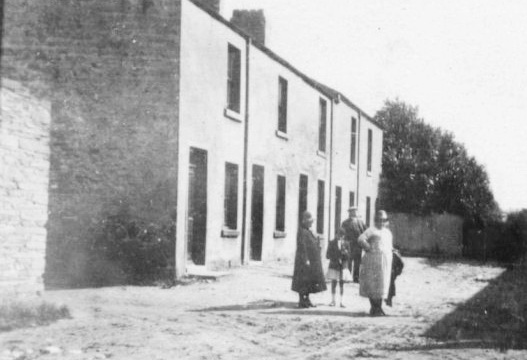
I recently received a series of snapshots dating from 1931 showing the Johnson family in and around Ireleth and Askam. The first images, below, show the family outside the Railway Inn and then standing around in Dale St. The lady holding the coat is Elizabeth Johnson, nee Holmes.


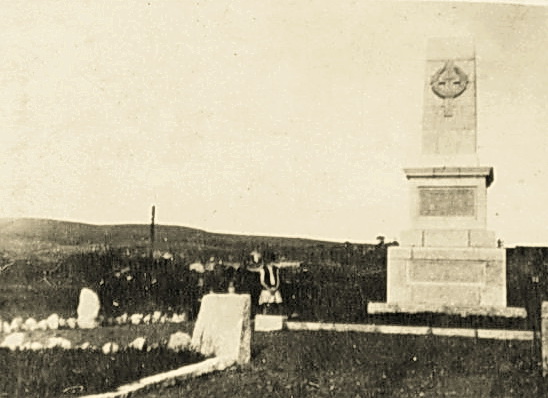
This delightful pic shows Mabel Johnson standing beside the recently unveiled War Memorial.


The darkness of the name panel suggests that the gilded letters of the names of the dead remained unweathered. It also suggests that the wreath and cross may have been partially gilded. The gold leaf was provided by the architect free gratis.

The final image is of the Johnson family on Askam Railway Station. They have put their coats on, it must have got cold!

Monday, 5 January 2009

Ireleth with Askam war memorial

Finally got round to looking in some detail at Askam war memorial, or, more properly, Ireleth with Askam.


The long eleven year struggle to establish this imposing monument commemorating the dead of a small mining village in the Furness peninsula is quite a fascinating tale. In the 78 years since its creation the monument itself has changed little but its environs have, as can be seen from these two images. The large blocks of limestone that originally marked the path in front of the memorial together with those surrounding the central area together with the bench have all gone. There are, however, a number of trees now - some quite mature and others planted more recently.

The long story of this imposing memorial starts soon after the armistice of 1918 when Henry Mellon, mining engineer, formed a committee from the village elite; James Poole Atkinson, Dr Cook and Rev E W Ridley, vicar of the parish. There were probably others. Together they resolved to invite Sam Grundy ARIBA of Ulverston to design a memorial.

Grundy drew up a comprehensive design for a village hall but it soon became apparent that against a backdrop of collapse in the mining and steel industry throughout Furness it was hugely over ambitious. He then suggested a memorial cross, to be erected at the station entrance. But this too was a non starter. In desperation the memorial committee finally ordered a bronze plaque for the local church

More to follow on this over coming weeks

Saturday, 26 April 2008

Lost memorial - Askam in Furness

On May 25, 1920 an article appeared in the Barrow News describing the unveiling of a war memorial at Askam in Furness commemorating 16875 Pte George Henry Jones, 1st Bn KORL, 'Fell in Action, Ypres May 24, 1915' - a former member of the town band. It was placed on what is described as the 'band stand' on the top floor of the Assembly Rooms beside the place where George, a cornet player, habitually stood.


The memorial, incorporating George's cap badge, was designed and made (in wood or metal?) by Mr Hargreaves a member of the band committee. The ceremony was presided over by Mr Henry Mellon, mining engineer, local councillor and JP and the unveiling performed by Myles Kennedy, owner of the Roanhead Iron Mines where
Private Jones had been employed before the war.
The whole audience rose and stood in silence while Mr Kennedy removed the Union Jack from the tablet, and remained standing while the band played The Dead March. The prayers of dedication were recited by Rev E W Ridley. Mr Wm Noall, of Dalton, rendered one of his original poems, entitled 'A Retrospect' in the course of which reference was made to the deceased soldier, who had been 'missed from the ranks, but found up in Heaven'.

In his address Myles Kennedy alluded to the fact that one hundred and ten men joined the forces from the Roanhead workforce of whom eight were killed in action and three died of wounds.

The assembly Rooms were demolished sometime around the time of WW2 and the memorial presumably lost. As I write this, however, Mr Harry Barker of Askam, a long time member of the Town Band is attempting to discover whether or not it survives in the village, perhaps in the possession of a relative of Pte Jones.