Search This Blog

Saturday, 6 December 2008

Generosity - Nathan Harker Leach - Selside


Looking at the many war memorials through the county it is self evident that in almost every instance vastly more were killed during the Great War than in the second World War. Indeed, quite a few communities seem to have suffered no losses between 1939 -45.

At Selside, a small fellside community on the southern approaches to the Shap fells, a roll of honour and a brass plaque were erected after 1918 listing all who served and died.
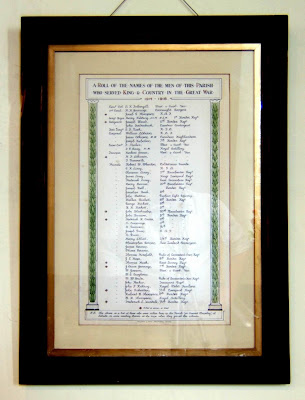
No names were added after 1945 giving the impression that the village escaped fatalities in the later conflict. However, this was not the case.

On 12th May 1944, 25 year old Nathan Harker Leach, a driver in the Royal Corps of Signals, died of wounds in Italy and is buried in the Commonwealth War Graves Cemetery in the countryside south of the town of Ancona. He was probably wounded in the Eighth Army's advance up towards the Gothic Line during the spring of the year. My own father was part of these actions.

Nathan was the son of Thomas Ellwood & Mary Leach of High Borrowbridge, Selside. Thomas was the local road mender - a man of low social status. For some reason his son's death was not commemorated in the community.

A few years ago I was sunning myself by the ancient church of St Anthony, Cartmel Fell and struck up conversation with a couple of guys, clearly gentry, one of whom hailed from Selside. It appeared that some years before one of these guy's had, I think at his own expense, paid for a memorial for young driver Leach.


A nice gesture

Friday, 28 November 2008

Lych gates

Through the course of the nineteenth century the established church struggled to find a place for itself in an increasingly secular society. The encounter with mass death of 1914/18 propelled it centre stage and by 1919 onwards it had regained its place as a primary repository of memory. I do struggle to understand the dynamic which prompted small communities to invest relatively large sums of money in lych gates, but I guess they are appropriate. In mediaeval times the coffin would rest here prior to being given Christian burial, a final farewell. In the years following the war each new generation of a village or parish would pass the names as they made their rites of passage thro' christening, marriage and death.

There are considerable numbers of lych gates in the county. That at Plumpton on the old A6 south of Carlisle is particularly attractive. It stands at the approach to the delightful Deco church of St John the Evangelist built 1907 in a beautiful creamy sandstone to a design of Sir Robert Lorimer. Always locked but must get in; it has a Morris window!


A slightly less ambitious affair is this memorial gate at New Hutton a lovely quiet spot above Kendal.

Set at the village end of a long church approach it has two panels, a dedication and a short list of names. Within the Webster church of 1828 there is also a small wooden cross with name brasses and formerly an organ (see earlier posting!). I believe there is also a roll in the village hall, but I have never managed to get in to check this out

Lych gates were also appropriated for personal memorialisation. At Sebergham this elegant structure commemorates a young officer, Captain William Adamson of the 6th Bn Loyal North Lancashires.

An old boy of Sherborne School, he was killed in Mesopotamia on April 24 1916 aged 31. His name appears on the memorial to the missing at Basra - clearly his body remains unidentified somewhere in Iraq, a long way from the hills and fells. His parents William & Eliza were of Langham Tower, Sunderland though an inscription on this memorial describes him as being of 'Greenfoot', presumably near Sebergham. I know nothing more of him.

I was talking to a friend earlier this week who once did a Master's in Law. He observed that such as memorial brasses, windows or lych gates might be tax deductible; churches are, and were c1919, charities! Adds another dimension to theories of altruism and the 'gifting' of memorials!

Thursday, 13 November 2008

Brian McGuire, Royal Dublin Fusiliers - killed at Mons 1914

There are many sad stories associated with memorials throughout the county - pretty obvious really. But when I was first getting involved in them I found one which seemed to say a lot about the way in which the dead of the Great War were remembered until quite recently. To all intents and purposes they were largely forgotten - and indeed many, including this guy, still are. Nor is it everyone who treats memorials with the respect that they deserve.


In Ulverston cemetery there are quite a number of family headstones & gravemarkers that bear the names of men who died during, or as a consequence of, the Great War. One such is this neglected memorial to the McGuire family.


The memorial itself is broken. The cross which originally surmounted the base, & which has vanished completely, probably fell as the monument sank into the grave. Upon the base can be read the words;

In Honoured Memory of
Brian McGuire, 2nd Lt
Royal Dublin Fusiliers
Younger son of
George McGuire
Fell at the Battle of The Aisne, France
14th Sept 1914, aged 20 Years
How sad that it is so neglected. But it seems that there was probably no-one to care for it.

Brian's father died on May 8, 1899 aged 37 and is buried in this plot with Eleanor, Brian's grandmother, who died August 3, 1880 aged 50. In his working life George was Town Clerk of Bradford. Brian's medal card shows that his mother, Florence Hannah, remarried becoming Mrs Craven. She probably lived at Collingworth, Yorkshire in 1914/15 and later in 1917/18 at Beaufort Mansions, Chelsea. By the early '20s she was at 'The Bungalow', Freshwater Bay, Isle of Wight.


Young Brian McGuire is buried at Vauxbuin, a concentration cemetery adjacent to large French and German war cemeteries. It was established after the armistice and contains close to 300 British dead of which 162 are identified. These bodies, mostly of 1918 casualties, were brought in from about a dozen dispersed burial sites around Soissons. Interestingly the CWGC website indicates that one grave at Vauxbuin contains the remains of a man killed in September 1914 and whose initial burial place was at Pargny-Filain, a German Communal Cemetery. Was this Brian McGuire?


I briefly checked on the web to see whether Brian McGuire is listed on Bradford's Memorial and was appalled to discover that a week before Armistice Day, 2008, many of the bronze plaques naming the dead had been ripped off the memorial and stolen.


Tuesday, 11 November 2008

Cartmel Valley Memorials

Just had an email from Howard Martin. His website on the War Memorials of the Cartmel Valley is up at running @ http://members.lycos.co.uk/aitch11/
Apart from anything else it has, or soon will have, some great pics of the valley

Monday, 10 November 2008

My family's story of Remembrance

I know this blog was supposed to be about Cumbrian War Memorials, and mostly it still is. But you must forgive me if I slip in one or two postings about other stuff around the general theme. Yesterday I went to the cross at Ulverston and watched the Ceremony of Remembrance. That was after watching The Cenotaph on TV in the morning. On the Saturday evening I had also watched the Festival of Remembrance. Overkill you might think. But I find it all intensely moving.


When I was a child watching the Festival of Remembrance with my family was the most important event in our year. We sat in the lounge with a big open fire and sang the old, familiar songs of The Great War with Ralph Reader. Indeed Remembrancetide, as my gran called it, was far more emotionally charged than Christmas. In May 1918 my grandfather was killed in France. On 19/20 December 1941 my mother lost her only cousins, Harry & Cliff Waterworth, when their ship HMS Neptune was sunk off the Libyan coast (see http://www.hmsneptune.com/ ). Their father, Harry, my gran's brother, died of a broken heart soon after.
The last photo of Harry & Cliff aboard the Neptune. Writing home to their young wives, Sally & Doreen.

My own father fought with the 50th Royal Tank Regiment from the Battle of Alam Halfa in July 1942 through Sicily & Italy and on into the Greek Civil War. In Athens in 1945 he had the job of scraping the blasted remains of George Sprackland, his driver and dearest friend, off the side of a building and shovelling him into sandbags. How do you deal with that??


My father is extreme left, George second left. In the Western Desert, 1942.


This spot of film shows a few of the appalling events of the Greek Civil War, probably in Athens. The Tanks are perhaps of my father's unit who reclaimed their armour after a brief period as infantry.


So now when I watch these the events of Remembrancetide I am again with my family. I feel the presence of Sarah Elizabeth Alice my lovely gran, Claribel and Harry, my mother & father. What a man he was. A wonderful guy and an amazing Dad. At this time I miss them though they have been dead 20-30 years. I never valued them then.

I personally feel that Blair and others who voted on a lie for our involvement in America's wars, including John Hutton, my illustrious MP, should be made to spend a month with the families of war dead before sending boys out to kill & be killed. I loathe them for what they do in my name.

If kids are reading this - give yer mum 'n dad a hug. And yer gran 'n grandad! Ask them about their lives..........

Saturday, 8 November 2008

At the going down of the sun ............

Remembrance


Whitbeck - Cumberland


Bit of info on this from Andy.........

"This simple, yet poignant, little memorial has always fascinated me ever
since I first noticed it about fifteen years ago. It tends to get hidden by
the fuschia during Spring and Summer !!

The Private Harold Mutton listed on it can present the war memorial
researcher with a bit of a puzzle.

He is described as being in the King's Own Yorkshire Light Infantry and as
having been killed at Loos, although he is officially commemorated by the
CWGC as being in the Border Regiment and having been killed at Ypres
(commemorated on the Menin Gate).

However, being intrigued by this discrepancy, I did a bit of digging and
found that he had, in fact, been transferred to the KOYLI from the Border
Regiment and was serving with them when he was killed during the Battle of
the Somme. Hence, he should be commemorated on the Thiepval Memorial!!

I have passed on my findings to the MoD to have his commemorative details
corrected but there is no response from them as yet."


Friday, 7 November 2008

Drowned on the Lusitania

It is too easy to imagine that all the casualties of war are military; men and women who signed up for service in the full knowledge of the dangers they faced in or around combat. However, the wars of the twentieth century were total wars engaging entire populations and vast numbers of civilians were killed.

One of the seminal events of the Great War was the sinking of the Cunard Liner RMS Lusitania on May 17, 1915 off the south coast of Ireland while making her way back to Liverpool from New York. Torpedoed by the U Boot U-20 she sank in 18 minutes with huge loss of life. Of 1,959 passengers aboard, 1,198 drowned. Many of the dead were Americans, people of wealth and influence. Indeed, the ship's sinking contributed to the United States eventual entry into the war.


In the parish church at Grange-over Sands there is a small plaque commemorating Evan Arthur Leigh of Yewbarrow Hall who was one of the dead. He was born on 28th April, 1850 the son of Evan Leigh of Newton Square, Manchester. After attending Mill Hill school he became an Engineer and Merchant of the firm of Leigh and Butler, Boston, U.S.A., and Temple Chambers, Brazenose Street, Manchester, and founder of E.A. Leigh & Co., 196, Deansgate, Manchester.

He was a major benefactor in Grange.

For details of the Lusitania disaster and a history of the ship start out at http://en.wikipedia.org/wiki/RMS_Lusitania