Search This Blog

Wednesday, 1 September 2010

A mystery of the Sequoiadendron giganteums or Wellingtonia trees of Temple Sowerby

I was watching TV a few weeks ago, one of the many second rate reality shows that wastes hours, time & energy. This one featured a young dentist with a lot of dosh looking for a house somewhere round the Lakes. He finally put an offer on an impressive Victorian mansion at Temple Sowerby, a delightful village at the west end of the Stainmore road approaching Penrith. I was reminded of a trip out a few weeks earlier when I had traced most of the memorials in the same village. During this trip I was lucky enough to meet a local farmer and his wife who were happy to fill in some details. At one point we stood by her front gate and she pointed to a house by the main road, the same that appeared on the TV programme, and pointed out a huge tree in its garden, soaring above all the others around it.

Apparently this tree, a Wellingtonia or more properly the North American Giant Redwood - Sequoiadendron giganteum - is one of four that were planted in a long line running north-south across the village. The best seen is that which stands at the entrance to Acorn Bank, a National Trust property standing some way north of the village. 
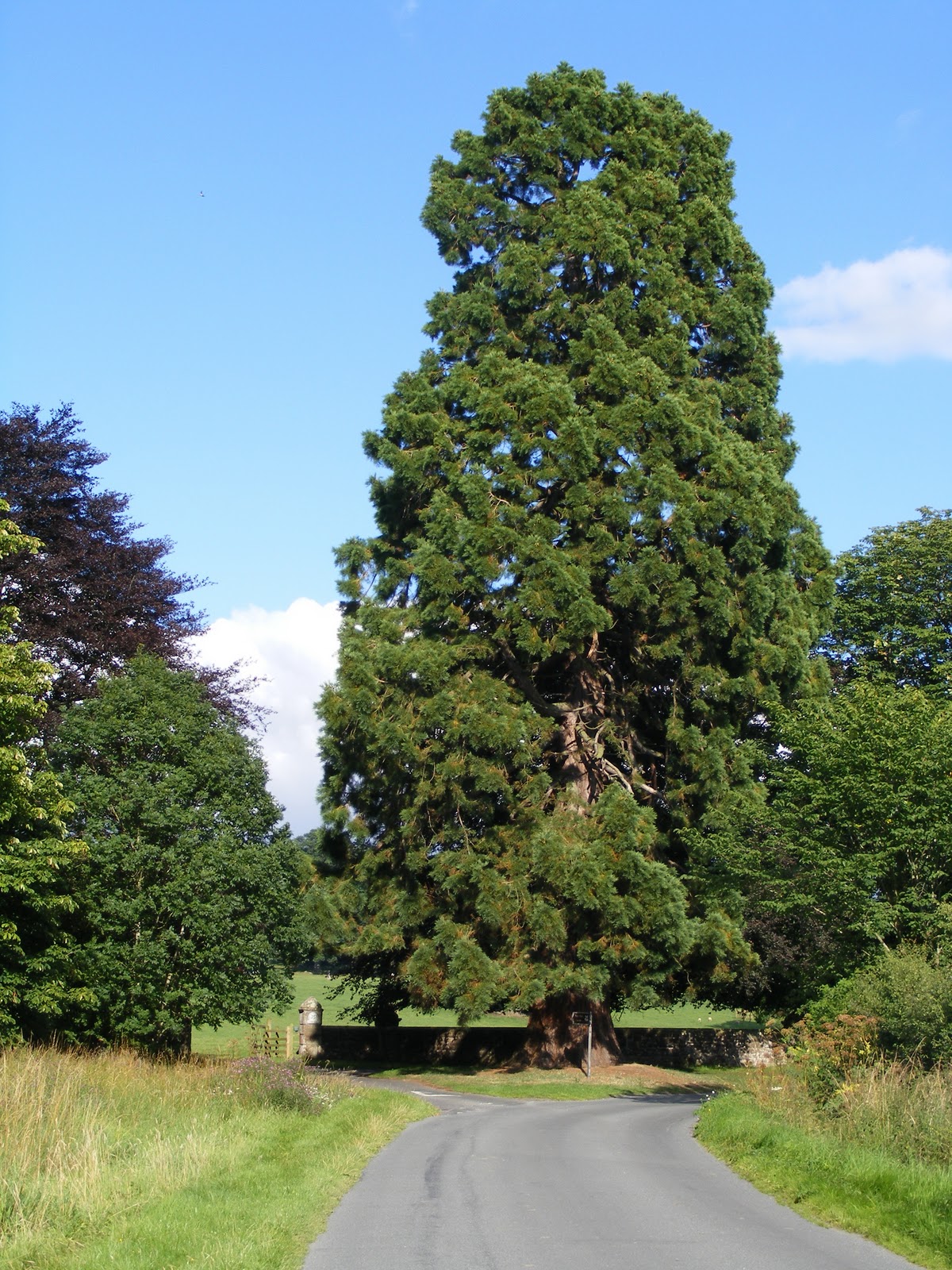
 

A War memorial? Don't know, but the lady I spoke to said that the trees were planted to celebrate the Battle of Waterloo. The tree's seeds were first cultivated in Britain in 1853, Waterloo was in 1815. Maybe they were planted to commemorate Arthur Wellesley, the Duke of Wellington after whom the tree was named in Britain and who died in 1852. 

Maybe somebody out there knows the full story.

Friday, 20 August 2010

A Hero of the Confederacy

Just borrowed a book from the library 'The Stained Glass in the Churches of the Anglican Diocese of Carlisle', by Leslie Smith. I've bought a copy too, at a reasonable price from ABE Books, but it's not arrived yet! When I get books like this it's quite frustrating because I realise how many memorials I have missed - although there are one or two the book has missed!! I did it again this last week when visiting St Cuthbert's church, Cliburn - which prompted a return visit today.


What a lovely little church with the modern wayside cross on an ancient base.

The book tells me that there is a small stained glass window in the north wall of the sanctuary. It has two small flags in front of it, one an odd stars and stripes - confederate? - and the other listing the names of a series of battles from the American Civil War...
 

In the book the window is described as having 'Florets in gold, fleur de lys of the same, a Coat of Arms & Motto...'. Though unsigned and undated it is listed in the catalogue of Cox & Sons of London, later to be Curtis, Ward & Hughes.


The window was inserted to the memory of Confederate Major General Patrick Ronayne Cleburne, killed at Franklin fight, November 1864.

The dedication plaque reads:

In Memory
of Major General Cleburne
C.S.A.
Born 17th March 1828
Killed at the Battle of Franklin Fenn
30th November 1864


There is an awful lot about the General on the web - start here or at Wikipedia here! Rising from the ranks he was called the 'Stonewall Jackson of the West' & fought in many of the iconic actions of the American Civil War; Shiloh, Chickamauga, Missionary Ridge, et al. You can even buy computer games and re-fight his battles....


Among the mass of info available on the web across the pond is this picture of his kepi & pistol.

The Wiki page describes him as being Anglo Irish, born in County Cork but the family lived in Cliburn and the Eden Valley for some four centuries. There are a number of other Cleburne memorials in the church including an undated armorial window with figures of Christ & the Magdalene and another to Cuthbert Lowther Cleburne, died 1870 as an infant in the USA. And just across the lane outside the church there are the much denuded remains of Cliburn Hall, the family home from the 14th century, seen here as it was in the 19th century


There is a further American Cleburne memorial brass attached to the font cover ...


The church is fascinating; there is a cut-down Roman altar built into the porch and the south door is clearly very early. These ancient doors are often in evidence in the north of Cumbria and I often wonder whether they are pillaged from one of the many Roman buildings that must have littered the landscape in the 10th & 11th centuries.

Monday, 16 August 2010

A Cumbrian Soldier

Sapper Darren Foster of Carlisle. 21 Engineer Regiment.


Died of gunshot wounds in the Sangin District of Helmand, Afghanistan, 14 August 2010.

Corporal John Rutter, Section Commander, 73 Armoured Engineer Squadron, said:
"Sapper 'Cookie' Foster was a Sapper through and through; although new to the Squadron he possessed the qualities and capabilities of a soldier beyond his years.
"He gained the name 'Cookie' by making the mistake of telling the section that cooking was a passion of his and was duly appointed head Engineer Chef, however this was not the only reason why he shone within the Section, it was his hardworking and enthusiastic approach to work, accompanied with his friendly personality that made him the sapper he was.
"As an intelligent and skilled sapper he fitted in with the section from the start and was liked by all. We only had the privilege of knowing 'Cookie' since he deployed and joined us at Forward Operating Base Sangin Fulod, but within that time he has made a lasting impression on us all that we will never forget...
"Rest in Peace mate."

Tuesday, 27 July 2010

Finsthwaite Tower

Up above Finsthwaite, on the opposite side of Lake Windermere from Fell Foot and the tides of tourists heading up towards Bowness there is a tower on a hill. Now obscured by trees it was once visible for miles around.


Originally of three storeys it was built in c1799 by James King of Finsthwaite as a memorial to the exploits of the Royal Navy.


Interestingly Mannex, in his History & Topography of Westmorland and Lonsdale North of the Sands (1849), suggests that the 'observatory' was in fact built in 1797 and talks of people carving their names in the wooden frame. Was there an earlier, timber tower? Perhaps he talks of the door frame?
.
There is a dedicatory inscription ...

ERECTED
To the Memory of
The Officers, Seamen and Marines
of the
ROYAL NAVY
whose matchless Conduct and
irresistible Valour decisively defeated
the Fleets of France, Spain and Holland
and preserved and protected
LIBERTY and COMMERCE
1799


In 1798/9 things did not look good. Britain was deeply involved in the wars with Revolutionary France which appeared to carry all before it. Ireland was aflame and receiving French support, and British India was threatened by Tippoo Sultan, The Tiger of Mysore. In the previous year Napoleon had taken Malta and set about conquering Egypt with the intention of marching on to India to join up with Tippoo and then jointly booting the Brits out of the sub continent.

However, the best laid plans of Old Boney came to naught courtesy of Nelson who obliterated the French Fleet at Aboukir Bay in the Battle of the Nile, Egypt on August 1, 1798. In October of the previous year Admiral Duncan had defeated the Dutch Fleet, then allied with the French, at Camperdown


James King was clearly impressed by the Navy's achievements. He did, however, have a personal interest. His father's marriage bond of 1751 describes him as aged 35 and 'lately surgeon on HM Ship Loo'. James senior was a Liverpool man but married Isabel Taylor of Finsthwaite (1722-66). James junior was born in 1755 and eventually inherited Finsthwaite House from his mother's younger brother, Edward (1731-90). James continued to live there until his death in June,1821, an old bachelor.

There was no such ship in the Royal as an HMS Loo but there have been a number named HMS Looe.
  •  32-gun fifth rate launched in 1696 and wrecked in 1697.
  •  32-gun fifth rate launched in 1697 and wrecked in 1705.
  •  42-gun fifth rate launched in 1707. She was reduced to harbour service in 1735 and was sunk as a breakwater in 1737.
  •   44-gun fifth rate launched in 1741 and wrecked in 1744.
  •   44-gun fifth rate launched in 1745 and sunk as a breakwater in 1759.
  •  30-gun fifth rate, formerly the privateer Liverpool. She was purchased in 1759 and sold in 1763.
The ship wrecked in 1744 lies off the coast of Florida and is a popular diving site. It had a dramatic end. Indeed its undoubted fame was probably the prompt for the ship's inclusion in James senior's marriage bond. But that cannot be a certain conclusion without further research at the Royal Naval Museum archives.

Thanks to Janet Martin for the pics and info

Afghanistan


The Taleban are, I think, a fearsome foe for western armies. They are totally motivated and quite ruthless; they will not tolerate foreign forces on their soil. But it has been so for generations. Their fathers and grandfathers fought the British to a standstill for more than a hundred years, then the Russians and now the Americans who, courtesy of Butcher Blair, dragged us back into the present, Fifth Afghan War. Thus far they have always won ... and following the revelations on Wikileaks it seems they may well continue to do so. Throughout this whole miserable business the tribesmen of this extraordinary country have inflicted grievous casualties.

Perhaps the Afghan's greatest success was in utterly defeating the British forces under General Elphinstone in the First Afghan War of 1839 - 42. The Brits, fearful of Russian influence, decided to impose a friendly and malleable figurehead on the country and proceeded to replace the popular Dost Mohammed with their own dissolute and corrupt puppet, Shuja Shah. Realising that Shah would never survive alone, 10,000 troops were dispatched to support his regime and local warlords were bribed to keep their peace. It didn't last. In the Autumn of 1842 the Afghans rose up, besieged the Kabul cantonment and threw the Brits out. In the subsequent withdrawal through the snow of the Jugdulluk & Khyber passes some 16,000 British and Indian troops and their camp followers were massacred.

 
If you are ambushed here in the passes, as the Brits were, there is nowhere to run. What a place to die.

Of all those who left Kabul Dr William Bryden was the only man to ride into safety at Jalalabad. This famous painting by Lady Butler provides a fanciful impression of his salvation.


Of the many who died one at least is commemorated in Cumbria, at Wreay, near Penrith, where stands, surely, the most extraordinary church in the County, a fantasy of styles drawn from across Europe.

The church which replaced an earlier structure was designed and built by Sarah Losh, (1785 - 1853), the daughter & heiress of a local landowner, drawing on architectural features that she had encountered whilst on a 'Grand Tour' with her sister, Catherine, about 1817. The basic form is that of a classical Roman Basilica. All the work was done by estate servants; the wood carving in particular is spectacular with its angels, birds and animals. Sarah never married but she was clearly a woman education and taste.


Looking again at the photograph of the nave there are two carved pine cones, symbolic of eternal life, at the edge of the pic. Others can be found elsewhere in the church. The choice is deliberate, for in the corner of the graveyard is an enclosure containing the burials of the Losh family and their friends and other memorials concentrated here from the cleared graveyard. Among these is another large pine cone and an inscribed block of stone that originally stood beneath a tree, now long gone. The inscription reads ...


This Kheuat Pine is Planted
in Memory Of W Thain, Major
of the 23rd Ft. It Was Raised
From Seed Transmitted by Him to
 Friends. He Perished in The
Fatal Pass of Coord Cabul
...... ..... ..... Lamented by All
Who Knew Him

Thain died in the snow of the Jugdulluk pass. He was a close friend of the Losh family and had fought with a Colonel Elphinstone at Waterloo where he was slightly wounded by grape shot near La Haye Sainte while serving as Adjutant of the 33rd Foot in Halkett's Brigade. Is this the same Elphinstone who led the retreat from Kabul?

Apart from the pine cones Thain's death is also believed to be commemorated by the recurrent symbol of the arrow which is a striking feature of the west door of the church.


The fatalities of the First Afghan War were commemorated in India by the building of the church of St John in Bombay (Mumbai) where the many names - of Officers - are listed. Forgotten men from forgotten wars.

Here is a short film of St John's church today, a relic of Empire.


Saturday, 24 July 2010

Calthwaite

As a consequence of travelling round the county of Cumbria I have acquired a considerable collection of church guides. Written by vicars or local enthusiasts they describe the origins and history of the buildings, windows, artifacts but rarely war memorials. They are seldom valued as objects of craftsmanship. Thus it was rather nice to visit Calthwaite church and discover quite a comprehensive description of the memorial in the church guide.

The church, designed by JH Martindale Diocesan surveyor for Carlisle, was only built in 1913. It is a lovely building, quiet and peaceful and contains some magnificent wood carving done by George Fendley of Warwick Rd, Carlisle.


The war memorial is another example of the work of Beattie of Carlisle. 


Close examination provides a glimpse of the way in which the rifle and helmet were drawn out of the Aberdeen granite. The sculptor drilled holes around an outline allowing the detail to be isolated and worked on.

The church guide describes the unveiling ceremony ...

58 Calthwaite men joined the armed forces of whom 12 were killed in action ... The Memorial was unveiled on Sunday afternoon, 16th January 1921, by the Earl of Carlisle, who lived at Calthwaite Hall as a boy and had no doubt known many of the men commemorated. The service, conducted by the recently instituted vicar, The Rev WW Farrer, was short, simple and impressive. ... The congregation sang the hymn 'The Saints of God' and then went outside to gather round the memorial. Lord Carlisle reverently withdrew the Union Jack which covered the inscription, and the vicar and Mr Reece offered dedicatory prayers. Two buglers from Carlisle Castle sounded the Last Post.

Charlie Foster, one of the men commemorated, was the son of the headmaster of Calthwaite School, who recorded his death in the school logbook in October 1917, adding the comment 'No singing today as master not in singing mood'.

Such grief from war. For what?


Wednesday, 21 July 2010

Return to Clifton - The Last Battle on English Soil

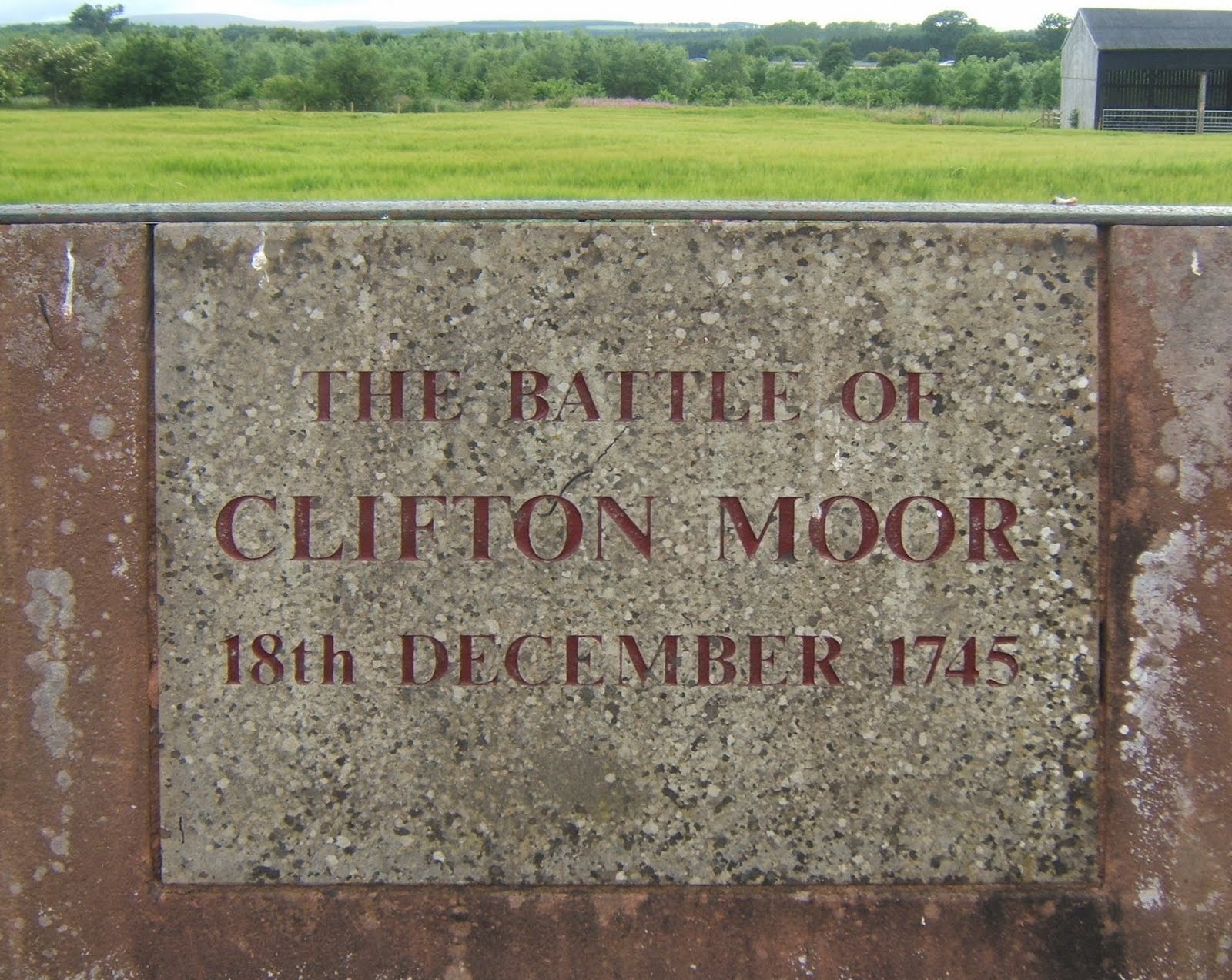
By far the most popular posting on this blog is that which describes the Battle of Clifton ... The Last Battle on English Soil. I recently found myself driving down the old road and took the opportunity, with my mate Rod, to take some more pictures of Battle memorials in the village.

Herewith is a close-up of the dedication plate on the stone put in place below 'The Rebel Tree' by the Goodchilds in 1936.


There is also a dedicatory plaque placed on the renovated fence and gate by Scots patriots around the millenium.

In Memory of Fellow Scots Who Lie Here in Foreign Soil.
Never Forgotten.
Prosperity to Scotland And No Union.

Siol Nan Gaidheal


On the east side of the A6, just a few yards south of The Rebel Tree, lies an ancient Holy Well, now enclosed and 'made safe' in true Health and Safety fashion. It appears that this too was adopted as a further battle memorial.


It has two plaques built into its fabric.


The allusion in the inscription below to a tree planted in 1995 on the 250th anniversary of the skirmish is confusing. There is no tree anywhere close by so I guess this plaque has been relocated to the well's enclosure from elsewhere.