Search This Blog

Showing posts with label Napoleonic. Show all posts

Tuesday, 6 March 2012

'The Temple' - Storrs Hall, Windermere


There are many buildings of note in Cumbria and the Lake District - some well known - some less well known. All have a history. One of the most elegant must be Storrs Hall on the East side of Lake Windermere, just south of Bowness. Since 1892 it has been a hotel, but for many years prior to this it was a private house.


 This old photo probably circa 1870 shows how it looked when in the ownership of the Rev Robert Staniforth who inherited it in 1848 from Elizabeth, the widow of John Bolton. 

John Bolton was an Ulverston lad, educated at Town Bank School, who made a vast fortune in the slave trade. A friend to Walter Scott, Canning, Southey and Wordsworth and many other Victorian elites he famously held a party that prompted Scott's son-in-law to say,  'It has not, I suppose, often happened to a plain English merchant, wholly the architect of his own fortunes, to entertain at one time a party embracing so many illustrious names.' A plain English Merchant! An odd sentiment to modern ears for one who owed all to the appalling trade in 'Black Gold'. 

Bolton acquired the house from John Pike Watts, a London Wine Merchant and uncle of John Constable. He in turn had bought it in 1804 from Sir John Legard, 6th baronet, of Ganton in Yorkshire (c1758-1808) who had bought the land and built the house during the 1790 and completed in  1797. It was around this time that he built 'The Temple'.


As noted in other postings, specifically that describing Finsthwaite Tower, the successes of the Royal Navy in the French Revolutionary Wars, fought against our ancient enemy, were celebrated by all classes. But it was the merchants and the middling gentry whose trade and fortunes were threatened who celebrated most as French and Spanish warships were swept from the world's oceans. In the absence of a continental army it was only the Royal Navy that could take the war to the foe, much like 1940. The Commanders were the superstars of their day. And here at Storrs Legard built his commemorative memorial to Admirals Howe, Duncan, St Vincent and the immortal Nelson.


Earl Howe gained a place on the memorial as a consequence of the action in 1793 known as 'The Glorious First of June' when he commanded a force that drove the French fleet into harbour where it more or less remained for a couple of decades.


Admiral Duncan gained distinction at the Battle of Camperdown in October 1797 when he defeated the Dutch fleet, then allies of Revolutionary France.


 John Jervis, Earl St Vincent, was a towering figure in Nelson's Navy. In 1797 he achieved a notable victory off Cape St Vincent against the Spanish fleet of 27 Ships of the Line with his own smaller force of 15.


Nelson.
At St Vincent with Jervis and though only a Commodore he was already a folk hero. He fought the Frenchie with a single minded determinatio to win. His exploits earned him a reputation that is almost unique and which inspired and defined the ethos of the British Navy for generations.


A full history of the Hall and its occupants can be found here.

Wednesday, 1 September 2010

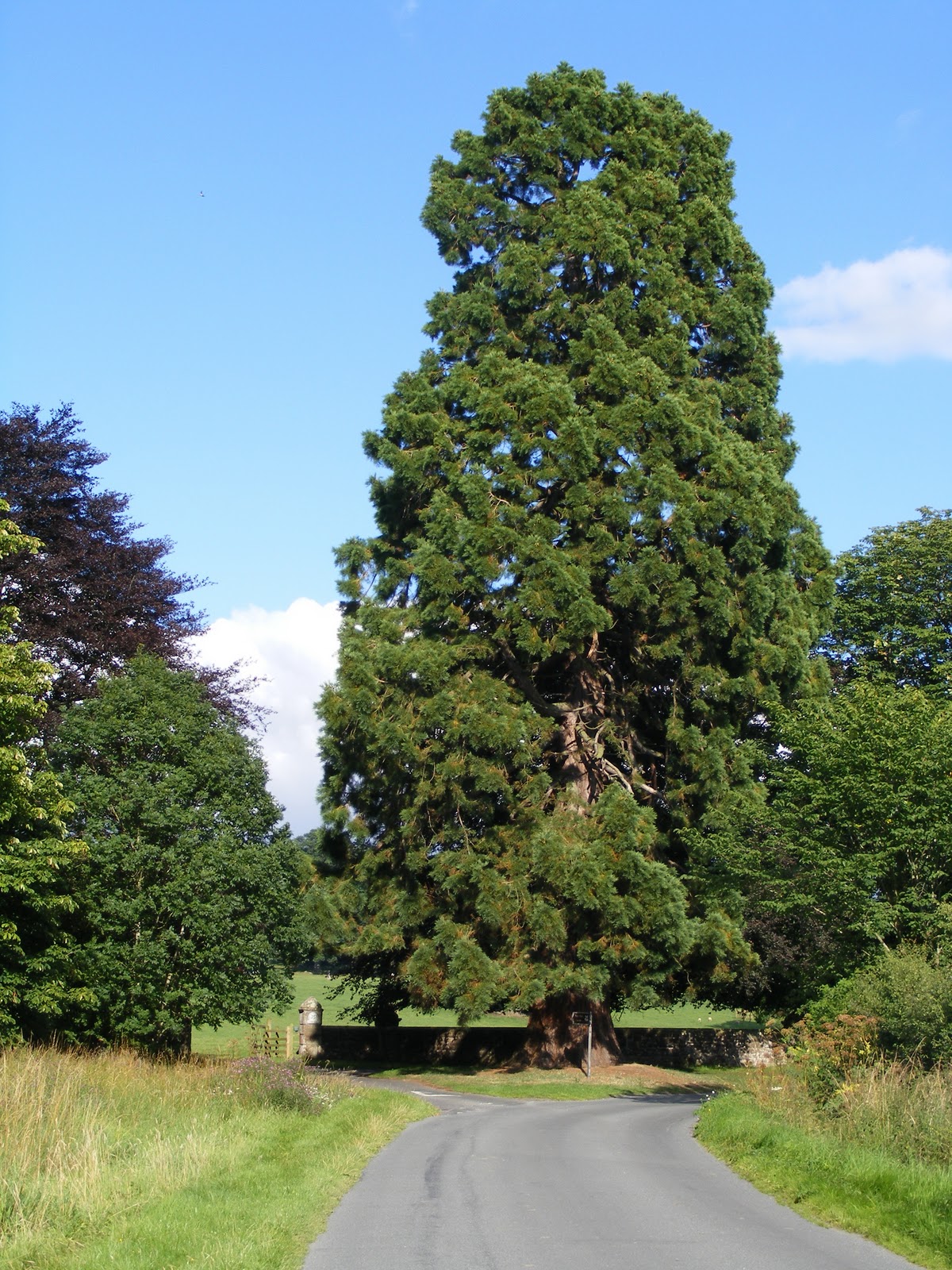
A mystery of the Sequoiadendron giganteums or Wellingtonia trees of Temple Sowerby

I was watching TV a few weeks ago, one of the many second rate reality shows that wastes hours, time & energy. This one featured a young dentist with a lot of dosh looking for a house somewhere round the Lakes. He finally put an offer on an impressive Victorian mansion at Temple Sowerby, a delightful village at the west end of the Stainmore road approaching Penrith. I was reminded of a trip out a few weeks earlier when I had traced most of the memorials in the same village. During this trip I was lucky enough to meet a local farmer and his wife who were happy to fill in some details. At one point we stood by her front gate and she pointed to a house by the main road, the same that appeared on the TV programme, and pointed out a huge tree in its garden, soaring above all the others around it.

Apparently this tree, a Wellingtonia or more properly the North American Giant Redwood - Sequoiadendron giganteum - is one of four that were planted in a long line running north-south across the village. The best seen is that which stands at the entrance to Acorn Bank, a National Trust property standing some way north of the village. 
 

A War memorial? Don't know, but the lady I spoke to said that the trees were planted to celebrate the Battle of Waterloo. The tree's seeds were first cultivated in Britain in 1853, Waterloo was in 1815. Maybe they were planted to commemorate Arthur Wellesley, the Duke of Wellington after whom the tree was named in Britain and who died in 1852. 

Maybe somebody out there knows the full story.

Tuesday, 27 July 2010

Finsthwaite Tower

Up above Finsthwaite, on the opposite side of Lake Windermere from Fell Foot and the tides of tourists heading up towards Bowness there is a tower on a hill. Now obscured by trees it was once visible for miles around.


Originally of three storeys it was built in c1799 by James King of Finsthwaite as a memorial to the exploits of the Royal Navy.


Interestingly Mannex, in his History & Topography of Westmorland and Lonsdale North of the Sands (1849), suggests that the 'observatory' was in fact built in 1797 and talks of people carving their names in the wooden frame. Was there an earlier, timber tower? Perhaps he talks of the door frame?
.
There is a dedicatory inscription ...

ERECTED
To the Memory of
The Officers, Seamen and Marines
of the
ROYAL NAVY
whose matchless Conduct and
irresistible Valour decisively defeated
the Fleets of France, Spain and Holland
and preserved and protected
LIBERTY and COMMERCE
1799


In 1798/9 things did not look good. Britain was deeply involved in the wars with Revolutionary France which appeared to carry all before it. Ireland was aflame and receiving French support, and British India was threatened by Tippoo Sultan, The Tiger of Mysore. In the previous year Napoleon had taken Malta and set about conquering Egypt with the intention of marching on to India to join up with Tippoo and then jointly booting the Brits out of the sub continent.

However, the best laid plans of Old Boney came to naught courtesy of Nelson who obliterated the French Fleet at Aboukir Bay in the Battle of the Nile, Egypt on August 1, 1798. In October of the previous year Admiral Duncan had defeated the Dutch Fleet, then allied with the French, at Camperdown. 


James King was clearly impressed by the Navy's achievements. He did, however, have a personal interest. His father's marriage bond of 1751 describes him as aged 35 and 'lately surgeon on HM Ship Loo'. James senior was a Liverpool man but married Isabel Taylor of Finsthwaite (1722-66). James junior was born in 1755 and eventually inherited Finsthwaite House from his mother's younger brother, Edward (1731-90). James continued to live there until his death in June,1821, an old bachelor.

There was no such ship in the Royal as an HMS Loo but there have been a number named HMS Looe.
  •  32-gun fifth rate launched in 1696 and wrecked in 1697.
  •  32-gun fifth rate launched in 1697 and wrecked in 1705.
  •  42-gun fifth rate launched in 1707. She was reduced to harbour service in 1735 and was sunk as a breakwater in 1737.
  •   44-gun fifth rate launched in 1741 and wrecked in 1744.
  •   44-gun fifth rate launched in 1745 and sunk as a breakwater in 1759.
  •  30-gun fifth rate, formerly the privateer Liverpool. She was purchased in 1759 and sold in 1763.
The ship wrecked in 1744 lies off the coast of Florida and is a popular diving site. It had a dramatic end. Indeed its undoubted fame was probably the prompt for the ship's inclusion in James senior's marriage bond. But that cannot be a certain conclusion without further research at the Royal Naval Museum archives.

Thanks to Janet Martin for the pics and info

Sunday, 16 May 2010

The Peninsula War at Bassenthwaite and Backbarrow

I can only say again what a remarkable tool the internet is.
A couple of enthusiasts from Longsleddale have a website that contains a huge collection of Cumbrian maps and an increasingly large collection of photographs. Browsing through the pictures I discovered this image of a memorial in St Bega's Church, Bassenthwaite.

The memorial commemorates Walter Vane, Captain in the 1st Foot Guards (Coldstreams) who died of wounds received at the Battle of Bayonne on 14 April 1814. This action was a rather bitter affair fought 2 days after the abdication of Napoleon on April 12. As Arthur Wellesley pursued Marshall Soult into France he left a force of some 20,000 troops under Lt Gen John Hope to invest the city of Bayonne. After a leisurely six week siege the French Commander, Thouvenot, though aware of Napoleon's demise launched a column against the British lines. The Brits lost 838 men, the French 905. General Hope was captured.
Captain Vane was buried close to the village of Boucat (Boucau).

'along with many of his brother Officers who bravely fell in the service of their country'.

No mention of the common soldier there then! Indeed they were largely forgotten, only receiving a medal for their services in The Peninsula in 1848. This old veteran seen below wears his peninsula medal sometime around 1860; a wonderful image held at the V&A in London.


However, many veterans were lauded in their home communities. In Ulverston an old soldier who lost an arm at Waterloo and who lived at 'Waterloo Cottage' on the Flan reputedly never bought a pint of beer in his life, simply regaling visitors with tales of the Battle for the price of his drink! And at Haverthwaite there is a remarkable tombstone commemorating William Fell, a Light Infantry Man who fought throughout the Peninsula War.

The inscription reads:

Requiescat in Pace
William Fell, A soldier of the 52nd Light Infantry who fought in that Gallant Regiment at Pombal, Almeida, on the Plains of Cordillia, at Sabugal, Busaco, Fuentes D'Onoro, at the siege and storming of Ciudad Rodrigo (a volunteer), Badajoz (severely wounded), Salamanca, Vittoria, and Orthez (dangerously wounded).Was born at Brow Edge and buried on the 27th of June 1852 in Haverthwaite church yard.
BG to whom he left his medal of six clasps dedicates to British valour this humble stone
BG is Dr Gilpin of Ulverston.

The image here shows a Peninsula medal awarded to a man in the 52nd Foot.


Leaving the army in 1821 after more than 12 years service William Fell returned to Backbarrow to work in a paper mill and later a Cotton Mill. In 1824 when claiming a pension in Dublin Fell stated that he was 'worn out with service'. He also worked as an armed guard on the local coach and as an old man made toffee and cakes for visitors to to the lakes, meeting them at Newby Bridge while wearing his medal. There is a full biography of him in CWAAS Transactions, 3rd Series, Vol IV.


The 52nd Light Infantry became the Ox & Bucks LI who famously landed at Pegasus Bridge on the Orne at the opening of the Battle for Normandy.


Wednesday, 21 April 2010

Bampton - in the valley of the Lowther

Summer is a comin' in so it's days out with friends. And a wonderful clear blue sky with no contrails! Yesterday to Shap and some of the villages in the valley of the river Lowther. Bampton Grange was one, with a name like that it must have been a grange of the Premonstratensian Abbey of Shap, a favourite place of mine. Its romantic ruins nestle in the fells some miles away.


The church at Bampton, an early 18th century building replacing a pre 1170 foundation, has three memorials to 20th century conflicts. One each for the dead of two world wars and a large wooden roll listing the guys who served between 1914/18.


The two stone ones might be Beattie's of Carlisle. They certainly have a look of their work.

There is also a Memorial Hall; is this a War Memorial?


However, the most interesting memorial is in a dark corner thro' the church door at the foot of the tower. It commemorates Vice Admiral Charles Richardson KCB, a man educated at the village school who made good in Nelson's navy. The memorial seeks to inspire other callow village youths to follow his example. The Admiral fought in the battles of The Glorious 1st June, Camperdown, at Flushing, the Indies, indeed he served King and country throughout the world for decades.

Richardson entered the Navy in November 1787 as servant to Captain Richard Strachan aboard the Vestal, 28 guns. In the early 1790s he was employed on various riverboats supporting Abercromby's operations against Tippoo Saib. By 1793 he was in the Channel Fleet aboard the Alexander, 74, under Captain West and in '94 the Royal George, 100, flagship of Sir Alexander Hood, in which ship he partook in Lord Howe's action of 1st June.

In August of 1794 he was commissioned Lt in the Circe, 28, under Capt Halkett, which was heavily involved in the mutiny at the Nore. In October 1797 Richardson was at Camperdown, a battle fought against the Dutch, and famously took an open boat to Admiral De Winter's dismasted flagship, took him prisoner and personally presented him to Lord Duncan, the victorious British Commander. Richardson was rewarded with promotion to signals Lieutenant aboard Duncan's flagship, Kent, 74. In 1798 he commanded a division of seamen in the Helder, took a Dutch 58 home as a prize before sailing with Abercromby to Egypt where he fought at Aboukir on 8th March 1801.

In July 1802 he took command of Alligator in which ship he directed operations leading to the reduction of Demerara, Essequibo and Berbice in 1803 and Surinam in 1804. As a consequence of these actions he raised his broad pennant in the Centaur, 74 and then the Caesar, 80. In this ship and in company with Richard Strachan, he pursued the French ships that escaped annihalation at Trafalgar, destroyed three French frigates at Sable d'Olonne, a French squadron at Aix Roads and then went on to land at the Scheldt where as senior Naval Officer he took the French surrender. During the investment of Flushing he commanded a battery of 24 pounders with sufficient effect to earn the praises of the Earl of Chatham, C in C British forces. In April 1812 Richardson commanded the frigate Semiramis and proceeded to take a significant number of prizes, among them the French privateer Grand Jean Bart, 14 guns. He continued to serve in the Channel, off Lisbon, the Cape of Good Hope and China until he was invalided out of active service in 1822.

What a career! What memories!

His prizes will have made him a wealthy man. Certainly he bought the estate of Painsthorpe Hall, East Yorkshire where he died, aged 81 in 1850. It is clearly a beautiful place.


Wednesday, 26 August 2009

More Trafalgar Veterans at Cartmel!

Following my posting about ancient Cumbrian Veterans I got an email from Howard of Cartmel.

In 2005 he wrote a short article for the parish magazine to commemorate the bi-centenary of Trafalgar. It was based around an earlier article published in the same mag in July 1917 reporting on a lantern slide talk given in the village by Admiral Powlett on the theme of The Navy.

Howard describes how after the talk Powlett proposed a vote of thanks to the Chairman of the meeting, Sir Evan MacGregor of Aynsome Manor, Cartmel....

who is the grandson of Nelson’s Captain at Trafalgar. The proposal was seconded by [the vicar of Cartmel Rev Godfrey Smith] the great-grandson of Nelson’s Chaplain... The printing for the lecture was carried out by the great-niece and great-great-niece of two of Nelson’s sailors, one of whom, Robert Thompson, is said to have died after having both his legs shot off, and the other, John Thompson, lost only part of a finger and lived in Cark for many years to tell the tale. One day, in the “Rose and Crown,” a young man made some slighting remark about the Navy, whereupon John Thompson said, “Say that again, young man.” The young man said it, and John promptly knocked his head through the wood panelling!


Nelson’s Captain on HMS “Victory” was Thomas Masterman Hardy (1769-1839). His grandson was Evan MacGregor, Knight Grand Cross of the Order of the Bath, a civil servant in the Admiralty for 47 years. He rose to the highest level where he served as Permanent Secretary to the Admiralty from 1886 until his retirement in 1907 following which he lived at Aynsome Manor until his death in 1926. He and Lady MacGregor worshipped in the Priory from 1908 onwards. His banner hangs between the British Legion banners in the North Transept where a commemorative plaque can also be seen. The family grave is in Grange cemetery, right in the corner nearest to Cartmel.


Dr. Alexander John Scott D.D. (1768-1840) was Chaplain and friend to Nelson for many years.


His great-grandson was The Reverend Godfrey Smith, Vicar of Cartmel until 1919. “Recollections of the Life of the Rev. A.J. Scott. D.D. Lord Nelson's Chaplain.” by Alfred and Margaret Gatty was first published in 1842. This biography was written by his daughter two years after his death and has been recently reprinted by Meriden Publications ISBN: 0954349504.


Monday, 3 August 2009

What's in a name?

Taking a bit of a leap of faith with this posting, or a leap of imagination.

Surnames are odd things! I guess they identify us, give us our individuality, but they also link us with the past. Until recently they could be a label of locale, of belonging, not simply to family, but to place; people didn't stray far until the nineteenth century. My Grandmother was a Waterworth. In the early years of the nineteenth century Waterworth's would only be found on the Lancashire/Yorkshire border and in one or two communities down south. Incidentally, every Waterworth on the planet is reputedly descended from one guy, a mediaeval Water Bailiff from Rufford in West Lancashire.

So what is in a name?

On the Great War memorials of Furness there are a number of names that are distinctly local; Woodburn, Pennington, Kitchin, Postlethwaite. They are names that occur in North Lancashire for generations. There are others who are not represented among the dead, Mackereth is one such.

Thus it was quite remarkable to be surfing the National Archives site and, coming across the full listing of Trafalgar veterans to find the name of William Mackeras.

William was born in Ulverston in 1780 and in 1805 was serving as an Ordinary Seaman aboard HMS Naiad, a frigate in Nelson's fleet, present at Trafalgar. Some years later a local paper carried a report on an event probably about Ulverston William...

WESTMORELAND GAZETTE, April 29th 1854

Mr. William MACKERETH, one of the remaining few of the heroes of Trafalgar, who has been residing for some time in Troutbeck, was on Tuesday last entertained by his friends on leaving the vale. The "Old Commodore" and "Mackereth's Gone to the Wars" composed for the occasion, and several appropriate songs, were sung on his health being drunk. The old sailor responded in a characteristic speech, and only regretted he was not engaged with the Baltic fleet where "England expects every man to do his duty."


Looking further I discovered that there were a stack of Cumbrians at the battle. Able Seaman Joseph Ben of Keswick served on HMS Bellerophon. Sam Wise of Skinburness served on the Polyphemus as a Master's Mate. Over 100 Cumberland men were there, mostly from the coastal ports of Workington, Whitehaven & Maryport, although there are a significant number from Carlisle.

Seamen Carousing - Julius Caesar Ibbetson - 1802

There were Westmorland men too. James Clarke of Ambleside fought in HMS Ajax. Mathew Hartley was a press ganged 51 year old married man from Kendal. His first ship was HMS Victory in which he served at Trafalgar. He survived the French wars and was discharged, presumably to make his way back to Kendal, in September 1814. At least 11 Westmorland men fought.

John Woodburn was a Private of Marines in the Leviathon; was he a south Cumbrian?

Check here for the story of the British Tar in paintings.

Finding all these names took me to the University of Southampton website and the database of men who fought in the 100 Years War, veterans of Agincourt, Orleans; Harry the Fifth's Band of Brothers.....

One of the principal families of mediaeval Cumbria was the Harringtons; there is the Harrington chantry at Cartmel Priory. Searching this name on the database, under 'Captain', threw up loads of names of common soldiers. One is William de Dunourdale, or in modern parlance William of Dunnerdale, who was an archer in King Harry's Expeditionary Force of 1415. He is listed in Sir John Harrington's muster roll and probably fought at Agincourt.

Alain Penyngton, knight, Richard Hudelston, John Penyngton, Nicholas Lamplogh, men at arms, William Threlkylde, archer; all served in John, Lord Harrington's Companies in 1415; all have Cumbrian names.

Thomas Makereth was an archer in the same Company. Was he a forefather of William Mackeras who served at Trafalgar?

Who knows!

It is easy to connect to the English Longbowman. Find an old unrestored church and look around the porch and there you may find grooves in the stonework such as these at St Anthony's, Cartmel Fell.

They were created by bowmen sharpening their arrowheads as they waited their turn to practice in the churchyard butts, anytime between c1350 - c1650.

Prints of the sailors pic can be purchased at The National Maritime Museum

Saturday, 14 March 2009

Sgt Thomas Gardner, Urswick.

My February 2008 posting about a memorial at Urswick has prompted a reply. It appears that Sgt Thomas Gardner was indeed a veteran of the 1st Life Guards at Waterloo. Born in Ulverston in 1789 he served in the army from 1808 until 1818 during which time he must have partaken in the action at Salamanca, in the Iberian Peninsula, and in the camapaigns of 'The Hundred Days' leading up to Waterloo.

The pic shows a Lifeguard at the time of the Battle.

Saturday, 6 December 2008

A death in Nelson's Navy - HMS Aeolus

Wonderful places - old churches - if time is taken to look around. They are rather like note books with monuments or memorials that act like prompts to remind the visitor of people and events long forgotten. Some, like a small memorial in the north of Cumbria, brush past famous men, in this case the immortal Nelson.
Kirkbride church is a small and ancient chapel built on the banks of the river Wampool. The chancel arch, described as Norman, may well have been the gate-arch of a Roman fort that once stood close by.


Set into the ledge of the window is a small marble memorial. It reads

SACRED
to the Memory of
WILLIAM METCALFE Midshipman
in His Majestys Ship AEOLUS, and
second Son of the Revd E Metcalfe
Rector of Kirkbride and HARRIET
his wife. Who died  6th Sept 1808
Aged 16 years


HMS Aeolus, a 32 gun fifth rate frigate launched in 1801 and broken up in 1817, was the second ship of the name. She fought throughout the Napoleonic wars and was involved at Santa Domingo (1803), in Strachan's action off Cape Ortegal (1805) and Martinique (1809). After Metcalfe's death she was heavily involved in the War of 1812 fought against American imperial ambition. On April 27, 1811 Frederick Marryat (1792 - 1848), who achieved fame for writing Mr Midshipman Easy & Children of the New Forest, joined the ship at Halifax, Nova Scotia.

Captain Frederick Marryat - E Dixon - c1830

He earned distinction by leading the effort to cut away the Aeolus' mainyard to save the ship during a storm off New York and, continuing a precedent set in earlier ships, saved one of his shipmates from the sea.


This painting shows a 36 gun fifth rate of the size and type of the Aeolus
So what of 16 year old Midshipman William Metcalfe? He probably joined the ship when she sailed from Portsmouth in August 1804 under Captain Lord William Fitzroy to serve the King at Weymouth. He may have partaken in Strachan's action of November 4, 1805 when some of the ships that escaped Trafalgar were captured. The prize money will have been considerable.

Strachan's Action After Trafalgar - Francis Sartorius- 1807
The Formidable, of 80 Guns, Dugay Trouin, Mont Blanc, Scipion, of 74 Guns each, which had separated from the remains of the Combined Fleet after the Action off Cape Trafalgar, were taken the 4th Inst. off Rochefort, by the Squadron under command of Sir Richard Strachan, consisting of the Cæsar, Hero, Courageux, and Namur Men of War, Revolutionaire, Phoenix, Santa Margaritta, and Æoleus Frigates, after an Action of 3 hours and a half. The Enemy had between 5 and 600 killed and wounded; our loss about 30 killed and 100 wounded. – The Cæsar, Courageux, Hero, and Revolutionaire arrived at Plymouth
In 1807 Aeolus was at Halifax. In the following year young William Metcalfe fell from the rigging. On these ships a fall is a long way down!
He was one of 12 children. His older brother, Francis, followed their father as vicar of Kirkbride. His next younger brother, Henry, was an ensign at Waterloo. John died at Madras in 1833 as a Captain in the army. Younger brothers Leonard died in Egypt as a Lieutenant, RN, and George died at sea. Some of his sisters married well, others found no match.
Quite a family, but typical of minor gentry where sons pursued careers in the church or in the forces of the crown and daughters sought husbands. Where would the Empire have been without them?
Prints of two of the pics can be purchased from the National Maritime Museum


Friday, 23 May 2008

Dr Jackson, Prisoner of War, Verdun, 1807

On Tuesday, February 7, 1807 The Times of London carried an article detailing recent events in the naval war against France. At end of of the article is a small footnote describing the death at Verdun of Dr Jackson on the 2nd of the month of a 'Putrid fever'.

I dug up this reference after yet another visit to lovely old Kirkby Stephen to get pictures of the memorials in the parish church, one of which commemorates the very same Dr Jackson, aged 29 and presumably of this town. Erected by a grieving parent the epitaph is taken pretty much verbatim from the article.


So why was he in Verdun?

The war with revolutionary France which had continued unabated since 1793 was temporarily suspended on March 25, 1802 with the signing of the Treaty of Amiens. It was a shaky peace and lasted only until May 18, 1803 when a declaration of war was laid before the British Parliament. As a response Bonaparte issued an order on May 22 that all British subjects within the borders of the French Empire be detained. Initially concentrated at depots in Fontainbleu, Valenciennes, Nismes & Nice they were in December ordered to Verdun.

The Times for September 20, 1805 carries a long article with lurid tales of how these events affected some of the higher caste detainees, such as the Marchioness of Tweeddale and Lord Elgin who was on his way home from an ambassadorial position in Constantinople with his marbles. Not a happy chap; at this time time his nose was rotting off with syphilis and while he was imprisoned his young wife, who was allowed to return home, struck up with one of her escorts. The pic shows His Lordship with a whole nose.

Indeed, one has also to feel sorry for Mr Churchill who had set out to France
to bring home a brother, who, by too copious use of quack
medicine, was in a state of imbecility.
It must be presumed that the fortress of Verdun became the holding centre for captured British seamen for on January 7, 1807, a further article in The Times describes the poor conditions they had to endure as prisoners. Their rations were a small square of Bullock liver, a slice of black bread and a glass of 'new brandy'. Both they and the civilian detainees had to pay for their own keep other than this and also pay their guards, the Gens -d'-Armes, ' a brutal set of people', at the rate of 6 francs per day. These frenchy rascals also claimed the right of sleeping in the same room as their prisoners, a suggestion that must have gone down like a lead balloon with the likes of the Marchioness of Tweedmuir! The author of the article suggests this poor treatment was part of of an attempt to subvert the seaman into joining French service, efforts that
to the eternal honour of our brave but unfortunate tars, were rejected with contempt and indignation. They resolved to perish rather than prove traitors to their country.
However,
A few renegade Irishmen, we regret to state [ ...] gladly accepted the proposals of the French, and were accordingly employed in their service.
Quite a tale behind just a simple memorial! But it would be nice to know more about Jackson.


Thursday, 14 February 2008

Waterloo veteran perhaps?

If the recording of 'war memorials' is interpreted quite loosely, as appears to be the policy of the UKNIWM, then some interesting stories emerge.

On the south wall of the chancel at Urswick parish church, facing the graveyard, is an old and rather weathered neo-classical funereal monument. The inscription on the central panel, inscribed in fine copper-plate, reads;

The non-commissioned Officers and Privates of the Furness Cuirassiers erected this monument in the memory of THOMAS GARDNER their Drill Sergeant formerly of the first Regiment of Life Guards who was killed by a fall from his Horse on the 21st Day of April 1821 in the 32nd Year of his Age


After the French Revolutionary wars and the defeat of Napoleon the armed forces were disbanded. Many of the veterans, particularly officers, subsequently raised units of volunteers. One such was the Furness Troop of Yeomanry known as The Furness Cuirassiers. They were raised at Ulverston on 22nd September 1819 under the command of Captain Thomas Richard G. Braddyll, formerly Captain and Lieut. Colonel in the Coldstream Guards. On 15th May 1828 the troop amalgamated with other local volunteer units to become the Lancashire Yeomanry Cavalry.
Given his age and the date of his death it is reasonable to assume that he may have fought in the Peninsula or at Waterloo. However, various early nineteenth century rolls, available online, do not include a Thomas Gardner serving with the Life Guards during the Napoleonic wars so any certainty about his service history must reamain unresolved.